
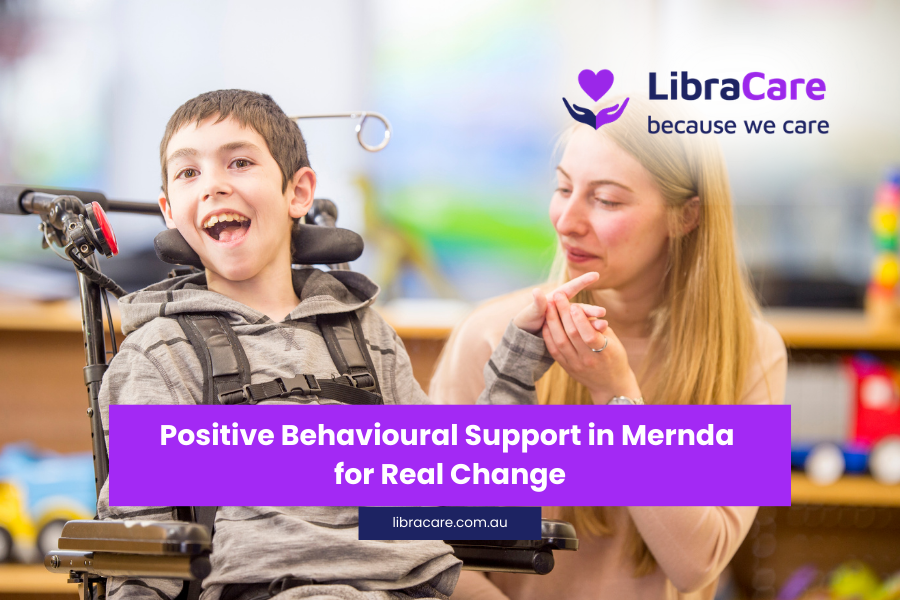
Navigating the NDIS can be quite a challenge, particularly when you are managing complex behaviours. For many families in Mernda, “challenging behaviours” aren’t just terms used by doctors, they are real-life hurdles that can put a strain on your home, make school days difficult, and limit your ability to enjoy everything our local community has to offer.
At Libra Care, we believe that every behaviour is actually a way of communicating. It is usually a sign that someone has a need that isn’t being met. That is why we focus on positive behavioural support in Mernda. Rather than attempting to engage in archaic means to attempt to control people, we go to the extent of trying to figure out the reason behind their actions. Once we know why we can do more to assist.
What is Behavioural Support anyway?
Likely you have encountered the term PBS in your paper NDIS documents. Positive Behavioural Support assists individuals with disability or having mental health issues by getting to know the person as a whole and dealing with the root cause of the behaviour rather than punishing it.
Our NDIS positive behaviour strategies focus on four main things:
- Finding the “Why”: We figure out the root cause. Is the person in pain? Are they frustrated? Are they being too noisy, or do they simply have no real choice of what they do?
- Teaching Skills: We assist them in improving ways of expressing what they require. To illustrate, when a child hits when he/she feels like having a rest, we explain to them that they use a break card or a sign.
- Fixing the Environment: We make things about them to make them stay calm. This may be rendering their home in Mernda quieter or ensuring that they are informed about precisely what is in their day.
- Honoring Rights: It is all about dignity at the end of the day. Every person has the right to a happy life whereby he/she is allowed to make choices.
Having a behaviour support practitioner in Mernda makes a huge difference because we are right here in your backyard, ready to help your family find some peace and move forward.
Why Choice of Location Matters: The Mernda Advantage
Why look specifically for a behaviour support practitioner in Mernda? Aside from avoiding the nightmare that is Plenty Road traffic during peak hour, local support offers tangible benefits for the success of a behaviour plan.
The “Natural Environment” Factor
Behaviours don’t happen in a vacuum, and they certainly don’t always happen in a doctor’s office. By working with disability support services in Mernda, our practitioners can visit your home, your child’s school, or your local workplace.
We see the triggers where they actually occur. Whether it’s the sensory overwhelm at Mernda Junction Shopping Centre or the transition stress of leaving the local park, being on-site allows us to tweak strategies in real-time. This is what we call “in-situ” support, and it is far more effective than office-based therapy.
Community Integration
Mernda is a growing community, and we support participants to confidently engage in local life. Our local practitioners assist in creating independence and community involvement using NDIS positive behaviour strategies.
The Detective Work: Functional Behaviour Assessment (FBA)
We must comprehend a problem before we can fix it. This is whereby the functional behaviour assessment (FBA) enters. Think of this as the investigative phase of our NDIS behaviour support services.
A common mistake in disability care is assuming that two people doing the same thing need the same solution. For example, two people might scream. Person A might be screaming because the lights are too bright (Sensory). Person B might be screaming because they want their iPad (Tangible). If you give Person A an iPad, they’ll still be in pain from the lights.
Our practitioners spend time:
- Direct Observation: Watching the person in their everyday life.
- Data Collection: Working with carers to track when, where, and with whom the behaviour happens.
- Interviews: Talking to the people who know the participant best—you.
The goal of the FBA is to identify the “function” of the behaviour. Usually, it falls into one of four categories: Escape, Attention, Tangible (getting something), or Sensory.
Crafting Your Individualised Behaviour Intervention Plan
Once the assessment is done, we move into the blueprint phase: the individualised behaviour intervention plans.
In the Australian disability sector, a “one size fits all” approach just doesn’t fly. Your plan is a living document, tailored specifically to the participant’s goals, triggers, and personality. A high-quality plan from Libra Care typically includes three stages of intervention:
1. Proactive (Primary) Strategies
These are what we daily do to ensure that the individual is happy and relaxed. It may involve a visual program to ensure they are aware of what is going to happen next, having regular sensory breaks, or just providing them with more options in the day. The objective is to render the “challenging behaviour redundant.
2. Early Warning (Secondary) Strategies
How do we know when a “rumbling” phase is starting? Maybe the person starts pacing, or their tone of voice changes. We identify these signs and provide clear instructions on how to de-escalate the situation before it turns into a crisis.
3. Reactive (Tertiary) Strategies
In some instances, we do our most, but a crisis occurs. These measures are aimed at safety, not only the safety of the participant but also the safety of other people, preserving the dignity of a person. Most importantly, the strategies are set in such a way that they are as not restrictive as possible.
Autism Behaviour Support in Mernda: A Specialised Approach
Autism behaviour support in Mernda is of high priority to many families in the City of Whittlesey. Autism is another form of experiencing the world, and behaviour of concern is simply a reaction to a neuro-heterosexual world.
Our approach to autism support is neuro-affirming. We do not want to train the autism out of a person; we want to help him or her flourish with it This involves:
- Communication Mastery: Many behaviours stem from the frustration of not being understood. We work closely with Speech Pathologists to integrate AAC (Augmentative and Alternative Communication) into the behaviour plan.
- Sensory Regulation: We help families understand the difference between a “tantrum” and a “meltdown.” One is goal-directed; the other is a complete nervous system overload. Our NDIS positive behaviour strategies focus on calming the nervous system, not punishing the person for being overwhelmed.
- Predictability: Using “First/Then” boards and social stories to help reduce the anxiety that comes with transitions.
The Libra Care Philosophy: Compassion Over Control
You might be wondering, “What makes Libra Care different from any other provider?”
It’s our “human-first” philosophy. As a provider of disability support services in Mernda, we’ve seen how clinical and cold the system can feel. We’ve heard from families who feel judged or like they’re just another NDIS number.
We take a different path:
- We Listen to Carers: You are the expert on your loved one. We do not enter and dictate to who we are working with.
- Mental Health Integration: Mental health issues are also experienced by most individuals with disabilities. Our group is educated to see the intersection of disability and mental health; that is, we do it holistically.
- Minimising Restrictive Practices: With the aid of individualised behaviour intervention plans, we assist our clients in the eradication of restraint and seclusion by the development of safe self-regulation skills.
Navigating NDIS Funding for Behaviour Support
We know the NDIS can be a bit of a headache. To access positive behavioural support in Mernda, you generally need a specific type of funding in your NDIS plan.
This is usually found under Capacity Building – Improved Relationships.
- Specialist Behavioural Intervention Support: This covers the creation of the plan and the expert advice from your practitioner.
- Behaviour Management Plan, Training in Behaviour Management Strategies: This covers the time the practitioner spends training your support workers and family members on how to use the plan.
If you don’t have this funding yet, don’t stress. We can help you prepare the evidence you need for your next NDIS plan meeting or review to show why this support is “reasonable and necessary.”
The Impact: What “Real Change” Actually Looks Like
What does success look like when you invest in NDIS behaviour support services? It isn’t just a decrease in “bad” days. It’s the “good” days getting even better.
Success is:
- A child who can go to the Mernda playground without a meltdown.
- An adult who feels confident enough to start a volunteer job.
- The family that will finally be able to have dinner together without worrying that something might happen.
- A learner that feels comprehended, esteemed, and in charge of their life.
This is the “Real Change” we talk about. It is all about creating something bigger than a diagnosis.
FAQs: Positive Behavioural Support in Mernda
Do we need an autism diagnosis to get help?
Not at all. While we do a lot of autism behaviour support in Mernda, PBS is for anyone with an NDIS plan. If someone’s behaviour is making life tough for them or their family, they can usually get support.
How often will you come over?
It really depends on your situation. Usually, we’re there a fair bit at the start while we’re figuring things out and writing the plan. Once things settle down, we move into a “check-in and training” phase to make sure the strategies are working in real life.
We’ve tried therapy before and it didn’t work. Why is this any different?
Mostly because PBS isn’t about trying to “fix” a person. It’s about changing the world around them and how people react to them. Often, other therapies fail because they’re too complicated or they don’t get to the real “why” behind what’s happening. We keep it practical and focus on the root cause.
Can you help with all the “Restrictive Practice” paperwork?
Yes, we’ve got you covered. If you’re currently using any restrictions, our team is qualified to handle all the NDIS reporting for you. More importantly, we’ll work with you to find better, more positive ways to manage things so you can hopefully phase those restrictions out for good.
A Final Word from Libra Care
Living in a state of constant high alert, wondering when the next crisis will happen, is exhausting. It’s hard on the participant, and it’s incredibly hard on the family. But you don’t have to do this alone.
By choosing positive behavioural support in Mernda through Libra Care, you’re choosing a team that actually cares about your family’s peace of mind. We are locals, we are experts, and we are ready to help you navigate the path to a calmer, more fulfilling life.
Are you ready to stop just “managing” and start truly supporting?
Whether you’re just starting your NDIS journey or looking to switch to a provider that actually “gets it,” we’re here. Let’s sit down, have a cuppa, and talk about how we can support your loved one to be their best self.
Take the First Step Toward Real Change Today
Contact Libra Care to chat with a behaviour support practitioner in Mernda. We’re ready to listen.
Enquire Now – Libra Care Mernda Serving Mernda, Doreen, South Morang, and across Victoria.